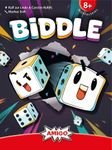
Preview of Biddle: a dice game for strategic challenges
In July, German publisher AMIGO announced some of its planned releases for late 2025. Among them, I have already had a chance to review Meister Makatsu, a title by Reiner Knizia. Today, however, I want to tell you about Biddle, a dice game for 2-5 players designed by Carsten Rohlfs and Ralf zur Linde.
Game Overview
Biddle is a game lasting about 30 minutes in which players face dice-throwing challenges. Each round, a challenge is presented that may require, for example, two tris, a sum less than 12, or four 3s and two 5s. The first player announces how many throws he or she thinks will be enough to meet the challenge, while the other players may accept the offer, propose fewer throws, or withdraw, thinking that the challenge cannot be completed with the stated number of throws.
Once at least one player has withdrawn, the participants who made the bet attempt to meet the challenge. If they succeed, they earn points; if not, the players who withdrew get the points. The game is played in ten rounds, and the scores increase over the course of the game. In this way, points can be earned both for doubting and for completing challenges, and in the end the player with the highest score wins.
Examples of challenges featured in the game
Biddle includes a reference card (in German) that explains the iconography of the cards, including:
- In the upper left corner, you need to get four 3s and two distinct numbers.
- In the middle left corner, all dice can differ from each other by a maximum of 2.
- In the middle of the second column, one tic of an odd value and a second tic of another odd value is required.
- At the bottom of the second column, a small ladder is required, along with three dice with values from 4 to 6.
- In the middle of the third column, there cannot be 2, 3, 4 or 5, but only 1 and 6 in any combination.
Playing Experience
I had the opportunity to try Biddle three times with a trial copy of AMIGO, with two, three and four players. The game is more engaging with a larger number of participants. With only two players, one person can place a bet and the other can withdraw, limiting the action to a single roll of the dice, which is less exciting.
With three or four players, teams are formed at each turn and the gameplay becomes more satisfying, whether you play alone or in pairs. Interestingly, regardless of each player’s role, either as throwers or supporters of failure, the score obtained for success is about twice that for failure. This aspect, as explained by Bernd Keller of AMIGO, makes it more difficult to score points than to bet on failure.
Strategy and game dynamics
An interesting feature of the betting phase is that it does not end until there are two teams. This forces players to make strategic decisions about the size of their bets. For example, if I bet on five tosses and everyone else accepts, I am forced to reduce my bet or withdraw. This dynamic makes the game compelling and encourages interaction among players.
During the course of the game, it is possible to keep track of scores, which affects future bets. In one game of three, I was within a few points of the leader, but a mistake in my bet led to a situation where I had no chance of overtaking him. In another four-way game, a player made a bold bet and won with 12 points.
In conclusion, Biddle represents an interesting reinterpretation of the classic dice game, introducing group dynamics that make for an engaging and strategic gaming experience.
About BoardGameGeek Blog